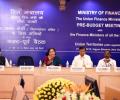
Sitharaman exhorted the states to work together with the Centre, stating that while the Union government sets the direction of economic growth, it is for the states to ensure effective implementation on the ground.

This meeting has led to the deferment of the Goods and Services Tax (GST) Council meeting by a day.
Despite a steady collection rate, the government faces a steep Budget target of Rs 6.1 trillion for CGST for 2019-20.

The US is pressing for taxing digital economy through the 'marketing intangibles' principle and the UK through a 'user-base' principle.

The report, floated recently, comes a few days after the government cancelled the registration of Bengaluru-based NGO Infosys Foundation for alleged violation of norms in receiving foreign grants.

The focus will be on tackling the unfinished agenda requiring immediate attention like tax structure for solar projects, uniform tax rate on state-organised and state-authorised lotteries, taxing non-potable alcohol besides certain changes in the law, extension for NAA and rate rationalisation.
There is talk of a fresh approach to a new labour code as well as reforming land acquisition laws in such a way as to be politically.

The rates of price rise in many services used by the common man, including hospital and nursing, cook, domestic help and bus (fare), among others, have also touched double digits during the last four years, putting a burden on disposable income.

Infrastructure projects were the top picks for MPs, with 40% of the total funds spent on the development of railways, roadways, pathways and bridges.

CBDT feels 30% growth in income-tax not feasible.

The direct tax collections are likely to fall short of the revised Budget target by Rs 650 billion and, in fact, were Rs 150 billion lower than the original estimate for the fiscal

With the two members quitting, the NSC now has only two members -- Chief Statistician Pravin Srivastava and NITI Aayog CEO Amitabh Kant.

Direct tax collections grew by a meagre 6.6 per cent during April-July of the current financial year against the Budget target of 14.4 per cent for 2018-19. Corporation taxes, in particular, grew at just 0.57 per cent, the lowest in the first four months in at least seven years.

The deposit has been made on account of the rate reductions approved by the GST Council in its November. The rate was reduced on items including shampoo, detergents, chocolates, beauty products, sanitary ware, leather clothing, cookers, stoves, after-shave, deodorant, detergent and washing power. Companies found it difficult to pass on the benefits to consumers immediately at the time of GST rate reduction owing to logistical issues.

Since its rollout 13 months ago, the new indirect tax has yielded Rs 1 trillion only in in April 2018
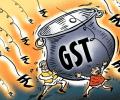
Rationalisation of rates will be taken up for smaller items that do not have major revenue implications but are commonly consumed at the GST Council meet on Saturday

Besides selling movable and immovable assets to make recoveries, taxmen filed prosecution cases against those not paying the demand.

The panel decided to omit the reverse charge mechanism (RCM) clause from the GST law under which registered taxpayers buying from unregistered taxpayers have to deposit the GST.

The central government wants to impose the levy; many states are opposed - at least, to the Centre doing so

After helping the government in policymaking since October 2014, Chief Economic Adviser Arvind Subramanian is returning to academics and will be teaching at Harvard Kennedy School on a visiting position. In an interview to Dilasha Seth and Somesh Jha, he says the ease of doing business agenda needs to move forward and India must try to integrate with the global value chains. Edited excerpts.
